

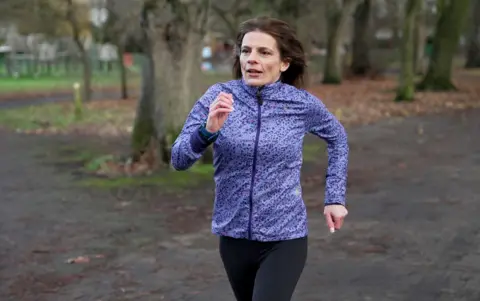
A sense of feeling of anticipation. I can see the cold breath coming from my fellow runners as they do the "starting line" jiggle on the starting line.
A swift movement of the hips.
I'm lined up for my local weekly parkrun event and I mean business. The countdown begins...
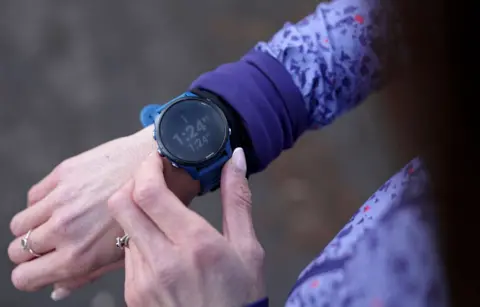
Hold on. I need to sort my device. The same goes for the runner alongside me.
The person waiting tuts. I won't start until… yes! Connection established, and I'm running.
In the mele, it's hard to spot a person without a smartwatch on it. And this isn't only us runners who rely on them.
We're witnessing a thriving, multi-billion dollar industry. Brands like Apple Watch are prevalent, all offering an extensive range of various devices to fit a variety of lifestyles. Based on how high tech the device you go for, price tags can start from an affordable sum to a significant investment.
"It makes me crazy, I'm unable to relax."
"It provides solace… It acts as a supporter encouraging me."
"I wish it wouldn't say I've had a poor sleep."
Just some of the reactions I've received from other tracker enthusiasts when I inquire what they think of theirs.
The Data Dilemma
My thoughts on mine? Currently, frustrating. It's telling me my speed is wrong, making me wonder whether the overhead branches along my route are disrupting my location tracking.
Countless individuals of us attach these small devices onto our wrists and use them constantly, apparently unconcerned with the fact they're constantly tracking us.
Gone are the days when we relied on them only to give us an estimation of our pedometer reading. Today, they can track our sleep quality, heart rate, heart rate variability (HRV), our VO2 max.
It's a challenge to find a bodily function they aren't designed to measure.
But can they do what they advertise? And are the numbers we obsess over a accurate representation of reality? Do they boost our daily wellness, or do the plethora of readings and motivational messages just add to our everyday anxiety?

A Love-Hate Relationship
"I do get a a little obsessed with mine," a wearer confesses.
While she values how her device records her runs, she finds some of its other features "daunting" at times - a feeling that became apparent during a pregnancy.
Until she found out she could change its configuration, her smartwatch repeatedly informed her she was being insufficiently productive enough. In a new phase, the watch insists her she's had a poor sleep score.
"I am caring for a six-month old, it's unnecessary for me to be told I've not slept," she says. "That fact is all too clearly."
Why doesn't she just remove it?
"I could, perhaps, but I've got this love-hate relationship with it," she says. "I appreciate it for its workout tracking, but I'm unsure whether the myriad other functions it can now do is maybe too much for me."
Inside the Device
Every device of smartwatch has its own unique way of tracking your health metrics and interpreting your data, but the most use detectors on the reverse of the watch.
They usually project small, green LED lights onto your arm which can detect capillary action, recording your BPM. Sophisticated devices measure changes in the skin conductance that passes over the skin to assess your recovery state.
Expert Perspectives
A data scientist says that for most people for smartwatches, it's a "difficult line" - while the ever-evolving tech could actually aid early diagnosis, "spotting abnormalities before we show symptoms", it could also turn us watch wearers into the "concerned but fine".
He points out that the most advanced wearables can perform tests like heart rhythm analysis, which regularly monitor how stable the heart is. They can flag if someone is experiencing a heart arrhythmia, where there is irregular impulses in the heart causing an uneven pulse.
This does not automatically signal someone is on the verge of a cardiac event, but it can give an advance notice they might be more vulnerable of a blood clot in the years to come.
But how to make sense of these figures is complicated. The expert concerns that as more functions are added, people may find it hard to fully comprehend their data.
"I remain sceptical that the ability to monitor so much data is such a beneficial thing," he says.
A professor studying wearable tech concurs. Her work into the impact of wearable tech on a set of individuals with health issues suggested a minority of those who were given devices to monitor their condition experienced increased anxiety and were "more inclined to use healthcare resources".
She observed a cycle with her patients - they noticed a concerning reading on their watch. They became worried. Their pulse increased. They got more worried. They re-examined the data, and their reading increased again.
"Upon viewing numbers about ourselves that we can't properly interpret then, of course, we are going to seek clarification," the psychologist says. "We check, we obsess - it becomes a feedback loop."


